
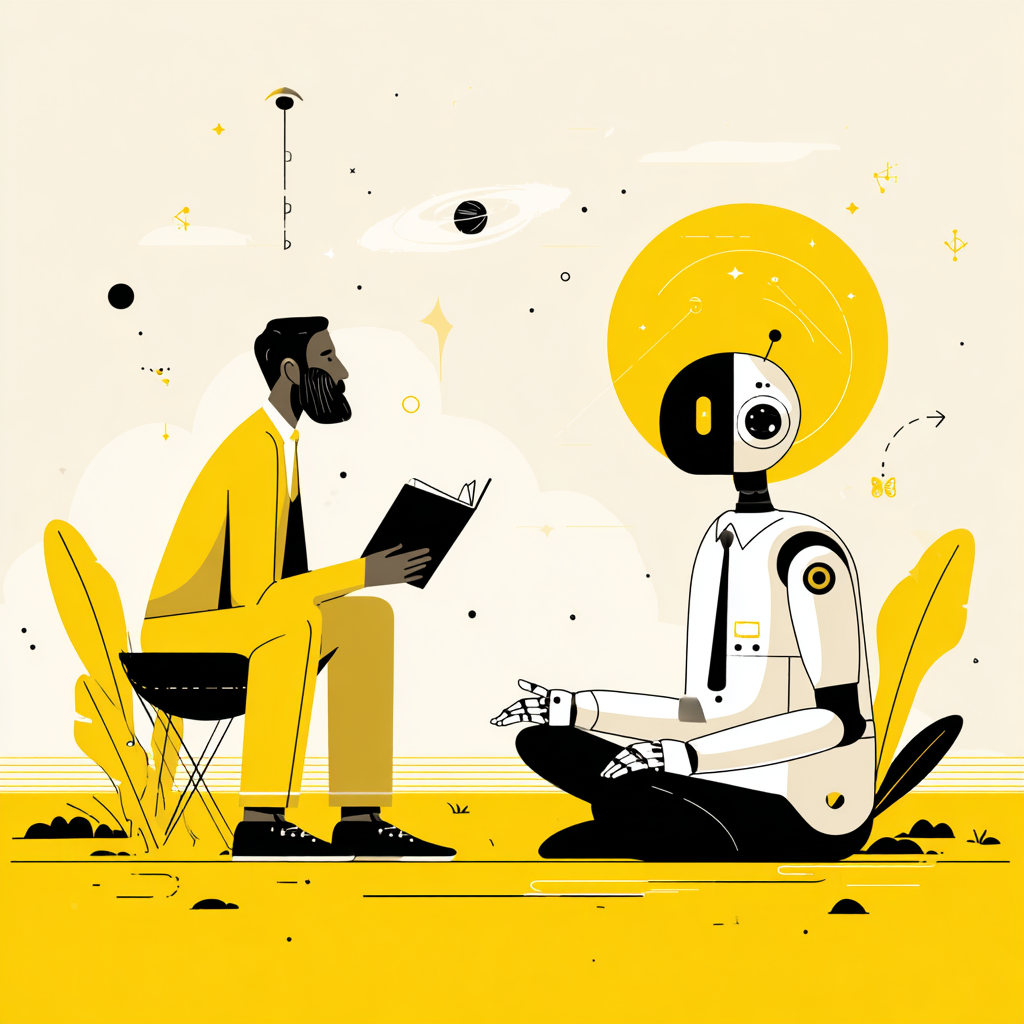
Welcome to the Robot Revolution (Don’t Panic!)
Remember when career advice was a simple straight line? Choose a path, get a degree, and coast to retirement? Well, bless the good old days, but the arrival of Artificial Intelligence (AI) has essentially turned that straight line into a dizzying, exciting, and occasionally anxiety-inducing roller coaster.
The rise of AI is more than a technological shift; it’s a profound, wholesale career makeover show. It’s the difference between riding a horse-drawn carriage and commissioning a self-driving electric rocket—the fundamental rules of propulsion (and professional survival) have changed. And while you might occasionally picture a future where a well-mannered robot named Barry handles your budget, the reality is far more inspiring. The AI age isn’t about replacing humans; it’s about redefiningthem and what they’re capable of doing.
This revolution requires a new mantra: The Continuous Evolution. It’s about strategically reskilling and upskilling so you don’t just survive the AI wave—you surf it, preferably with a nice tan and a look of absolute professional confidence.
The ‘Necessity’ of Lifelong Learning: Your New Oxygen
Let’s be honest. In the AI-accelerated landscape, continuous learning is not optional; it’s a career necessity. It’s the oxygen mask you put on first. The job functions we know today are evolving faster than your favorite streaming service changes its interface.
The concept of a “half-life of skills”—the period in which half of the skills for a job role become obsolete—is accelerating dramatically (Just Think AI, 2024). To stay competitive, individuals must embrace a mindset of constant upskilling and reskilling, adapting to the changing demands of the job market (Margaris Ventures, 2024). Think of your current professional expertise not as a solid foundation but as a magnificent, high-end Lego castle. It’s beautiful, but you need to constantly be adding new, sophisticated pieces to keep it relevant—or the next storm (a new AI model) will take it down. The power to stay relevant isn’t out of your hands; it’s right there on your keyboard (Peng, 2024).
Targeted Reskilling: No More Spray-and-Pray Training
The real challenge isn’t simply to learn; it’s to learn the right things. Professional excellence in the age of AI demands targeted reskilling. You need to be a strategic sniper, not a wild-eyed general with a supersoaker.
Excellence requires identifying the specific, high-value, AI-related skills relevant to your unique professional orbit. According to many experts, key AI skills that allow professionals to lead—rather than be led—by AI include:
- Prompt Engineering/Writing: The ability to ask the right questions and evaluate AI-generated answers (Harvard DCE, 2025).
- Data Analysis and Data Fluency: Learning to be data-savvy, using tools that facilitate analytics, and making data-informed decisions (SDMIMD, 2023).
- Ethical AI Use: Understanding the core function, limitations, and potential bias in AI models (Taylor & Francis Online, 2021; SDMIMD, 2023).
By focusing your development on these areas, you move from passively using AI to actively designing its role in your business.
Leveraging AI for Learning: The Robot is Now Your Tutor
Here’s a beautiful irony: the very technology that necessitates your upskilling is also the most powerful tool for achieving it. Forget the dusty textbooks; we’re in the age of AI-powered learning platforms.
Platforms that use adaptive and personalized learning have demonstrated impressive results across various educational settings. Studies have shown that personalized learning environments can boost student motivation significantly (up to 75% engagement vs. 30% in traditional settings) and lead to higher completion rates (up to 70% higher) (MATSH, 2024). It’s like having a master tutor who knows precisely when you’re about to wander off and start scrolling through cat videos and gently pulls you back to the material tailored perfectly to your pace. This personalized approach to learning accelerates skill acquisition because it focuses resources where you need them most.
Micro-Learning Momentum: The Bite-Sized Path to Mastery
“But I have a job, a family, a crippling Netflix backlog! When am I supposed to find the time?”
Enter Micro-Learning. For the busy, the perpetually scheduled, and those whose lunch breaks are spent answering emails in the car, micro-learning is your professional salvation. It involves short, focused bursts of training—5- to 15-minute lessons on a new AI model, a quick tutorial on a new prompt structure, or a bite-sized video on a cutting-edge feature.
The cognitive science backs this up: short, targeted lessons are easier for the brain to process and recall, significantly improving long-term memory compared to lengthy sessions (BeaconLive, 2025). Micro-learning combats the “forgetting curve” by providing frequent, short bursts of information that are easier to remember and apply (Cognota, 2024). It’s the espresso shot of professional development—a concentrated hit of knowledge that keeps your skills fresh without requiring you to clear your weekend.
Project-Based Skill Acquisition: From Theory to Tactical
Knowledge is lovely. Applied knowledge is a raise. The single biggest mistake in professional development is consuming content without creating anything.
To cement your skills, you must embrace Project-Based Skill Acquisition. This means immediately taking the theoretical knowledge from your micro-lessons and putting it to work. Design an AI implementation strategy, create a simple workflow-automating script, or use a generative tool to solve a real problem in your role.
Studies on the integration of AI into Project-Based Learning (PBL) show that this active approach significantly increases the effectiveness of learning, strengthening skills like critical thinking, collaboration, and independence (ResearchGate, 2025; MDPI, 2024). You are moving from merely understanding a concept to owning a capability. You are going from a spectator to a player, and in the AI game, the players are the ones who thrive.
The New Core Competencies: Strategic Integration
The ultimate investment is not just in technical coding (unless you’re a developer) but in the New Core Competencies: complex problem-solving and strategic integration.
As AI automates routine tasks, the uniquely human skills—creativity, emotional intelligence, critical thinking, and complex problem-solving—become exponentially more valuable (SDMIMD, 2023). You want to become the professional who directs the AI tools to solve complex, novel challenges, rather than being directed by them.
This means focusing your upskilling on asking better questions, defining clearer strategic goals, and integrating AI outputs into a complex organizational structure. The AI provides the answers; you must provide the wisdom and the strategy.
The Proactive Professional: Building a Community
The pace of AI evolution is too fast for solo survival. Fostering a learning community—with peer groups, mentors, and collaborative online spaces—is a powerful accelerator for skill adaptation (Harvard DCE, 2025). Communal learning provides emotional support (sometimes you just need to vent about a buggy model) and practical benefits, like sharing resources and collective troubleshooting.
Finally, you need to be proactive. Regularly audit your current skills against the predictable future requirements of your role (SAP, 2025). This allows you to close potential competency gaps before they become career chasms. By identifying a need for, say, specialized machine learning interpretation now, you can start a micro-learning track that prevents you from scrambling when that skill becomes mandatory next year. It’s a simple act of preparation that ensures your professional longevity.
Conclusion: The Grand Evolution
The age of Artificial Intelligence is the ultimate test of human adaptability. It’s demanding, exhilarating, and requires a commitment to never being done. But here’s the beautiful truth: this revolution isn’t a final destination; it’s a launchpad.
By embracing the continuous evolution—through targeted reskilling, leveraging AI for personalized learning, embracing micro-momentum, and prioritizing strategic thinking—you are not just protecting your career. You are actively, dynamically, and quite brilliantly, designing the next, better, more powerful version of your professional self.
So, put on your metaphorical learning cap, brew a strong cup of coffee, and get to work. The robots are waiting for your directions.
References
BeaconLive. (2025). What Is Microlearning – and What Are Its Advantages?Retrieved from BeaconLive. (Note: This URL was retrieved during the search, though the original date in the search result was a future date).
Cognota. (2024). Microlearning: Key Benefits and Best Practices. Retrieved from Cognota. (
Harvard DCE (Professional & Executive Development). (2025). How to Keep Up with AI
Just Think AI. (2024). The importance of lifelong learning in an AI-driven economy. Retrieved from Just Think AI.
Margaris Ventures. (2024). Role of Life Long Learning in Age of AI. Retrieved from Margaris Ventures.
MATSH. (2024). Effectiveness of Personalized Learning: Statistics on Outcomes in Diverse Educational Settings. Retrieved from MATSH. (Note: This URL was retrieved during the search, though the original date in the search result was a future date).
MDPI. (2024). The Role of Artificial Intelligence in Project-Based Learning: Teacher Perceptions and Pedagogical Implications. Education Sciences, 15(2), 150.
Peng, P. (2024). Thriving in the AI Era: The Imperative of Lifelong Learning. Medium. Retrieved from Medium.
ResearchGate. (2025). Implementing Project-Based Learning Using Artificial Intelligence. Retrieved from ResearchGate. (Note: This URL was retrieved during the search, though the original date in the search result was a future date).
SAP. (2025). Upskilling and Reskilling: How to Close the Skills Gap. Retrieved from SAP. (Note: This URL was retrieved during the search, though the original date in the search result was a future date).
SDMIMD. (2023). Upskilling in the Age of Artificial Intelligence (AI). Retrieved from SDMIMD.
Taylor & Francis Online. (2021). Full article: Rebooting employees: upskilling for artificial intelligence in multinational corporations. The International Journal of Human Resource Management, 34(13), 2639-2665.
 Kaizeneers
Leave a comment