

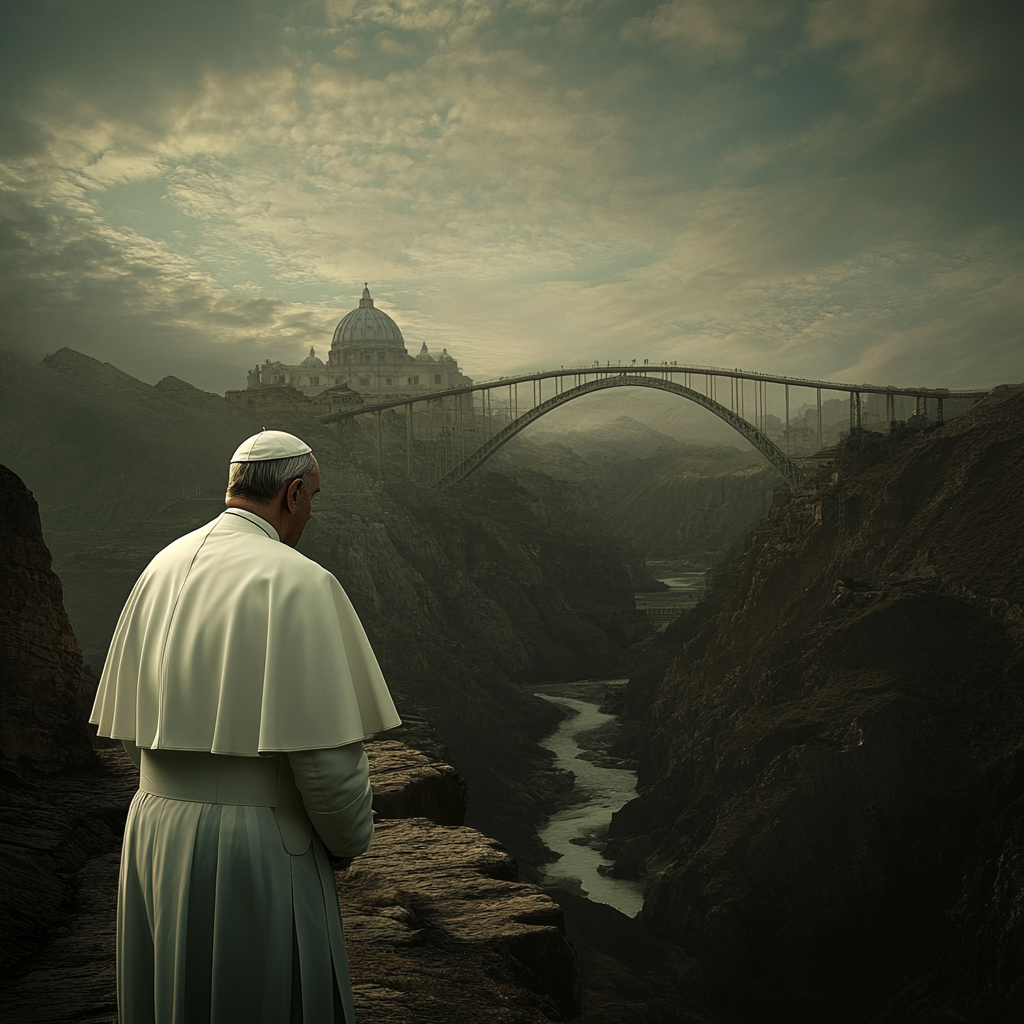
In Loving Memory of Pope Francis, A True Bridgebuilder of Our Time
Imagine a world where the very essence of our shared humanity shines brighter than any perceived difference. Picture communities where the diverse threads of faith are not walls that divide, but vibrant strands woven into a magnificent tapestry of understanding and peace. This isn’t a utopian dream; it’s the inherent potential that lies within the heart of spirituality itself. Yet, so often, the beautiful intentions of religion become obscured, the sacred texts misinterpreted, and the very notion of the divine used to draw lines of demarcation instead of circles of embrace.
Down through the ages, the human spirit has yearned for connection, for meaning that transcends the mundane. Religion, in its purest form, has always been the vessel for this yearning, a pathway to something greater than ourselves. The great spiritual leaders, the prophets and sages who have graced our planet, spoke a language not of division, but of profound unity. Their messages, echoing across continents and centuries, were not meant to be wielded as weapons of dogma, but extended as hands across chasms of ignorance.
Think of Pope Francis, a figure who embodied this spirit of connection in our modern era. His life was a testament to the power of humility and the courage of dialogue. He walked among the marginalized, spoke truth to power with gentle conviction, and consistently reminded us that beneath the labels and rituals, we are all children of the same vast and loving universe. His passing leaves a void, but more importantly, it ignites a call within us to continue his vital work – to become architects of sacred bridges, dismantling the borders that confine our hearts and minds.
The challenge we face is deeply rooted in the way we have often come to perceive and practice our faiths. Over centuries, the very structures meant to guide and uplift have, at times, inadvertently fostered a sense of separation. We see the emergence of what we might call “bordered minds,” where deeply held beliefs solidify into rigid pronouncements: “My truth is absolute,” “Our path is the only path,” “They are different, therefore they are distant.” This kind of thinking, however well-intentioned, constricts the soul, preventing the blossoming of empathy and understanding that lies at the core of spiritual growth.
These self-imposed borders ripple outwards, fracturing not only the potential for spiritual harmony but also hindering progress in crucial aspects of our shared existence. Religious tensions have fueled devastating ethnic conflicts, stifled the voices and opportunities of countless individuals, and tragically, been twisted to justify acts of violence that stand in stark opposition to the very principles of compassion and peace. If humanity is to truly thrive, to navigate the complex challenges of our time with wisdom and grace, we must consciously and courageously dissolve these invisible walls that separate us.
Yet, when we delve into the wellsprings of the world’s great spiritual traditions, a remarkable convergence emerges. The core teachings, the foundational principles espoused by figures like Jesus, the Prophet Muhammad, the Buddha, Laozi, and Guru Nanak, resonate with a shared mystical understanding of love, compassion, and liberation. Their wisdom was not intended to create factions, but to illuminate the interconnectedness of all life.
Consider the simple yet profound essence of these teachings:
- Christianity: The call to “love thy neighbor as thyself” is an expansive invitation to see the divine spark in every human being.
- Islam: The concept of the “Ummah,” the global community of believers, inherently emphasizes unity and brotherhood across all boundaries.
- Hinduism: The powerful mantra “Vasudhaiva Kutumbakam” – the world is one family – speaks directly to the interconnectedness of all existence.
- Buddhism: The principles of non-attachment and compassion cultivate a deep empathy and understanding for the suffering of all beings.
- Judaism: The concept of “Tikkun Olam,” repairing the world, underscores a shared responsibility for the well-being of all creation.
- Catholicism: The emphasis on “Caritas,” or divine charity, calls for selfless service and love towards all.
- Indigenous faiths: The deep reverence for the Earth and the understanding of our role as stewards of the natural world highlight a profound interconnectedness with all living things.
If the roots are so similar, why the persistent fractures? Perhaps it is because we have inherited interpretations and structures that have inadvertently emphasized borders of doctrine over the boundless bridges of shared human experience and mystical insight.
The mystics, those luminous souls who have peered beyond the veils of dogma into the heart of the divine, consistently speak a language of unity. Their voices, though arising from different traditions and times, resonate with a shared truth:
- Rumi, the Sufi poet: His invitation, “Beyond ideas of right and wrong, there is a field. I’ll meet you there,” speaks to a realm of understanding that transcends intellectual divisions.
- St. Teresa of Ávila, the Christian mystic: Her profound statement, “It is love alone that gives worth to all things,” underscores the unifying power of the heart.
- Rabbi Abraham Heschel, the Jewish thinker: His insightful observation, “God is not found in the answer, but in the question,” encourages a shared journey of seeking rather than clinging to rigid certainty.
- Yunus Emre, the Turkish mystic: His simple yet powerful declaration, “We love the created for the Creator’s sake,” highlights the inherent value and interconnectedness of all beings.
These voices, and countless others like them, create a sacred resonance, a space where truth is not a possession to be defended but a shared landscape to be explored with open hearts and minds.
How then do we actively become “sacred bridgebuilders” in our own lives and communities? Here are some visionary solutions to consider:
Spiritual Education Reform: Imagine a world where children are taught to encounter other religions not as alien systems of belief, but as different lenses through which the same universal values are expressed. Picture “Compassion Projects” in schools where young learners explore the teachings on kindness, forgiveness, and service across various faiths, discovering their shared essence.
Interfaith Arts & Ritual Spaces: Envision the creation of “Temple-Mosque-Church-Synagogue” galleries – spaces where the beauty of diverse artistic expressions and ritual practices can be appreciated beyond the confines of doctrine. Let shared moments of silence, the uplifting power of music, and the beauty of artistic expression become new sacraments of understanding.
Sacred Leadership Forums: Consider the potential of convening spiritual leaders from around the globe not to debate theological differences, but to collaborate on issues of planetary service and human well-being. Imagine a “United Sacred Nations” model, where religious wisdom informs and guides governmental policies towards justice, peace, and sustainability.
Digital Sanctuaries: In our interconnected world, let us create online sacred spaces where mystics, artists, and young people can gather virtually, transcending geographical and religious boundaries. These digital sanctuaries could become fertile ground for interfaith dialogue, artistic collaboration, and the sharing of mystical insights, fostering connection outside the often-politicized realms of organized religion.
On a personal level, the journey of bridge-building begins within each of us. Katarina, your own ancestral heritage speaks to this very idea. The magnificent Borobudur temple in Indonesia stands as a testament to the power of spiritual architecture to represent cosmic interconnectedness, a bridge between the earthly and the divine. In honoring the legacy of figures like Pope Francis, your own path calls you to cultivate inner “temples” of understanding that naturally radiate outwards, fostering unity in the world around you.
We must each engage in honest self-reflection, asking ourselves:
- Where within my own soul do I still harbor unconscious biases or limiting beliefs about those who are different?
- Have I ever allowed fear or prejudice to color my perception of someone based on their religious affiliation?
- What profound truths or expressions of the sacred might I be overlooking in another person’s prayer, ritual, or tradition?
The transformative power lies in the realization that when we actively choose to become the bridge, the world around us begins to reflect that unity.
A Call to Sacred Action: The Bridgebuilder’s Pledge
Let us each commit to tangible acts of bridge-building in our daily lives:
- Choose one quote or teaching from a faith tradition different from your own. Write it down and place it where you will see it regularly – on your mirror, your altar, or your workspace – as a reminder of our shared human and spiritual landscape.
- Reach out and share this article or a similar message of unity with someone you know who comes from a different religious background. Initiate a conversation, listen with an open heart, and seek to understand their perspective.
- Commit to one specific act of bridge-building this week. This could be as simple as engaging in a respectful conversation with someone of a different faith, offering a prayer for peace and understanding among all traditions, sharing a message of unity on social media, contributing to an interfaith charity, or even offering a gesture of kindness to someone you might have previously perceived as “other.”
In Memoriam: Pope Francis
Your gentle yet powerful voice echoed across the divides, shaking the very foundations of separation. You shared meals with the marginalized, honored the sacredness of our Earth, and offered gestures of profound respect to leaders and followers of every faith.
In your memory, dear Bridgebuilder, we make a solemn vow: we will continue the sacred work you championed. We will not erect towers of rigid doctrine, but instead, we will dedicate ourselves to building enduring bridges of divine love, understanding, and unity for all of humanity.
References
Pope Francis. Fratelli Tutti: On Fraternity and Social Friendship. Vatican City: Libreria Editrice Vaticana, 2020.
Armstrong, Karen. The Case for God. New York: Alfred A. Knopf, 2009.
Rumi, Jalal al-Din Muhammad. The Essential Rumi. Translated by Coleman Barks. New York: HarperCollins, 1995.
Smith, Huston. The World’s Religions. New York: HarperOne, 1991.
The Charter for Compassion. Charter for Compassion. Retrieved from https://charterforcompassion.org/
 Kaizeneers
Leave a comment