

Failure—long the harbinger of doom for the overly ambitious—has undergone a makeover. What was once the boogeyman of personal and professional life, lurking in the corners of our most guarded fears, has now found itself invited to the party. But not just as a reluctant guest. No, failure is now the guest of honor, and its celebration is louder than ever, especially in the era of social media and rapid technological innovation.
There’s even a buzzword for it: “Fail fast.” This is the mantra of Silicon Valley, the rallying cry of entrepreneurs, and the latest wisdom peddled by everyone from Instagram life coaches to corporate gurus. In essence, the “fail fast” mentality suggests that failure is not only unavoidable but desirable. By failing quickly and early, we can adapt, learn, and ultimately succeed sooner.
But how did failure, which once had the finality of a career-ending scandal or the devastation of a personal implosion, become the new badge of honor? And how does this shift shape our everyday lives—both in the office and around the dinner table? In this blog, we explore the rise of the “fail fast” mentality in personal and professional life, drawing from cultural shifts, social media discussions, and modern workplace trends. We’ll delve into why failure, when reframed, is not the end but the beginning of something better. And yes, we’ll sprinkle in a little humor—because when it comes to failure, laughter might just be the best coping mechanism.
The Origins of the “Fail Fast” Mantra: Silicon Valley and Beyond
Let’s start where it all began: Silicon Valley, the tech world’s Camelot. In this fabled land of innovation, where the stakes are high and fortunes rise and fall with every line of code, the fail-fast mentality emerged as the guiding principle. The logic behind it is simple: in a world where speed to market can make or break a product, there is little room for perfectionism or analysis paralysis.
Entrepreneurs like Elon Musk and Mark Zuckerberg have embraced failure as an inevitable (and sometimes brutal) teacher. Musk, who has spoken candidly about his numerous rocket crashes with SpaceX, frames failure as a critical part of the innovation process. “Failure is an option here,” he famously said. “If things are not failing, you are not innovating enough.”
Zuckerberg, too, embodies the spirit of fail-fast with Facebook’s development philosophy, summed up in the phrase “move fast and break things.” The idea? Don’t be afraid to disrupt the status quo—even if that means a few bumps along the way.
These titans of industry have been instrumental in reframing failure as a necessary pit stop on the road to success. The focus is on failing quickly, learning from it, and then pivoting toward something better. But what started as a tech world ethos has rapidly expanded into everyday life.
Social Media: Where Failure Becomes Content
Meanwhile, social media has not been far behind in transforming failure from a private embarrassment into a public spectacle. Platforms like Instagram, TikTok, and YouTube have elevated vulnerability as a currency. We’re now seeing influencers and everyday users alike capitalizing on failure, and in many ways, this is refreshing. After years of perfectionism cultivated by Instagram’s highly curated feeds, failure—or at least the perception of authenticity—has become the new #goals.
Take the rise of #FailFridays on Instagram, where influencers post about their missteps, both serious and trivial, to engage followers. On TikTok, where everything from botched dance routines to failed attempts at new recipes is celebrated with humor and self-deprecation, failure is rebranded as a moment of relatability. Just scroll through the endless parade of DIY disasters, awkward dating moments, or entrepreneurial setbacks, and you’ll find a world where everyone is laughing at their own missteps—and getting followers for it.
In the age of performative vulnerability, failure isn’t just tolerated; it’s monetized. Rachel Hollis, author of Girl, Wash Your Face, built her brand on the premise of imperfection, turning personal and professional failures into content that millions could relate to. In many ways, social media has democratized failure, turning it from something shameful into something that brings people together. If failure is inevitable, why not get some likes along the way?
The Psychological Shift: From Fixed to Growth Mindset
While Silicon Valley and social media have done a lot to popularize the fail-fast mentality, it’s psychology that has given it the intellectual backbone. Carol Dweck’s groundbreaking research on the “growth mindset” is often cited as one of the key theories supporting the fail-fast approach.
Dweck, a Stanford psychologist, argues that individuals generally operate with one of two mindsets: a fixed mindset, where they believe their talents and abilities are set in stone, or a growth mindset, where they see skills and intelligence as malleable and improvable through effort. People with a growth mindset, unsurprisingly, handle failure better because they don’t see it as a reflection of their inherent abilities. Instead, they see failure as part of the process of learning and growing.
In the fail-fast mentality, we see a direct reflection of the growth mindset. When we expect failure, we remove the sting of it. Failure becomes less about personal inadequacy and more about feedback—a necessary part of becoming better. From this perspective, it’s easy to see why “failing fast” has gained traction. After all, if we can treat failure as a learning experience, there’s less reason to fear it.
The Dark Side of Fail Fast: Not All Failure Is Equal
Of course, not everyone’s failures are treated equally. For every story of entrepreneurial redemption, there’s a cautionary tale about the perils of failing too often or failing too big. While the tech world has romanticized the idea of failure as part of innovation, there’s also a very real risk of fetishizing it—turning it into a gimmick rather than a genuine learning process.
Let’s not forget the infamous case of Theranos, the biotech startup led by Elizabeth Holmes, who was once hailed as the next Steve Jobs. Theranos, in its pursuit of disruption, glossed over critical failures in its blood-testing technology. Holmes’ refusal to acknowledge the limitations of the product—coupled with Silicon Valley’s obsession with moving fast—led to what can only be described as catastrophic failure. This wasn’t the kind of “fail fast, fail forward” moment you hear about in entrepreneurial circles. It was a lesson in what happens when we confuse recklessness with innovation.
Holmes’ story highlights the darker side of the fail-fast mentality: when failure is embraced without accountability, it can lead to disastrous results. While learning from failure is key, ignoring ethical responsibilities or brushing off mistakes under the guise of innovation can be just as damaging. It’s a fine line, and one that professionals must navigate carefully.
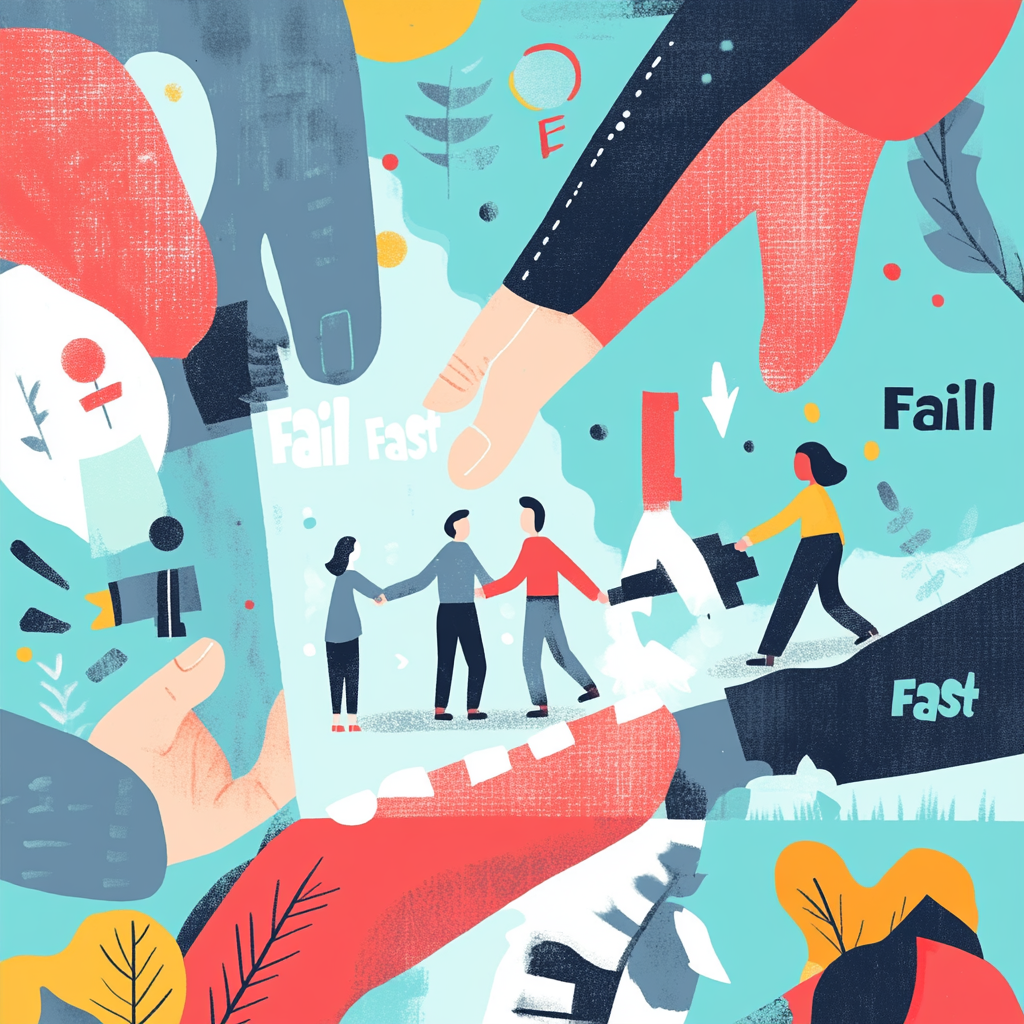
Failure in the Professional World: Growth or Setback?
It’s one thing to talk about failing fast in the context of tech startups and social media influencers, but how does this mindset translate to the average professional or workplace environment? While companies like Google and Amazon have embraced the fail-fast mantra, promoting risk-taking and innovation, not all industries are so forgiving of failure.
In traditional corporate environments, failure often still carries a heavy stigma. For many employees, the fear of making a mistake is so great that it can lead to analysis paralysis—where decision-making is so weighed down by fear of failure that nothing gets done at all. In these environments, failure isn’t seen as a stepping stone to success but as a mark against one’s career trajectory.
However, the tide is turning. More companies are recognizing that fostering a culture of innovation requires creating an environment where employees feel safe to experiment and fail. Psychological safety—the belief that you won’t be punished or humiliated for speaking up with ideas, questions, concerns, or mistakes—is now considered a critical element of high-performing teams.
Google’s Project Aristotle, an internal study aimed at understanding what makes teams successful, found that psychological safety was the number one predictor of a team’s success. In an environment where failure is accepted as part of the learning process, employees are more likely to take risks and innovate. While not every failure leads to a breakthrough, creating a space where failure is tolerated—and even encouraged—can lead to long-term growth and innovation.
Personal Failure: Lessons in Resilience
While much of the fail-fast conversation centers on professional life, personal failure plays an equally important role in our growth. In fact, personal failure might be even more transformative than professional setbacks because it strikes at the heart of our identity, relationships, and sense of self-worth.
Let’s face it: failing in your career is one thing. Failing in love? That’s another ballgame. Personal failures—whether it’s a relationship that ends, a friendship that falls apart, or a dream that doesn’t come to fruition—can feel devastating. But here, too, the fail-fast mentality can offer us a way forward.
Personal failure forces us to confront our vulnerabilities, and it’s in these moments that we learn the most about ourselves. Take relationships, for example. Dating apps like Bumble and Hinge have turned romantic failure into an art form, where swiping left and right becomes a metaphor for the trial-and-error process of finding connection. The modern dating world, in all its chaos, has fully embraced the fail-fast mentality: try, fail, try again—each time learning something new about yourself and what you’re looking for.
But beyond dating, the fail-fast mindset can apply to our personal growth as a whole. When we stop seeing failure as something to avoid and start seeing it as a critical part of our personal evolution, we can approach life with more resilience. We become more willing to take risks, to put ourselves out there, and to embrace uncertainty—knowing that even if we fail, we will be okay.
The Humor in Failure: Laughing Through the Stumbles
Of course, no discussion of failure would be complete without acknowledging the humor in it. Failure, as much as it stings in the moment, can be hilarious in retrospect. If we can’t laugh at our own mistakes, what can we laugh at?
Whether it’s trying to bake a soufflé only to end up with a pancake, or tripping on the treadmill at the gym, there’s something universally funny about failing—especially when it’s done with flair. Humor allows us to take the sting out of failure, to see it not as a personal tragedy but as a human experience. In fact, some of the best stories we tell come from our failures. Just think of all the viral content on TikTok that’s based on people’s epic fails—it’s not just about failing fast, it’s about failing with a sense of humor.
Conclusion: The New Era of Failure
In today’s world, failure is no longer something to fear. It’s something to embrace, to laugh at, to learn from, and ultimately, to grow from. Whether we’re navigating the fast-paced world of entrepreneurship, figuring out our next career move, or simply trying to make sense of our personal lives, failure is part of the journey.
The fail-fast mentality is not about celebrating failure for failure’s sake—it’s about seeing failure as an essential part of progress. In a culture that prizes innovation, authenticity, and resilience, failure is no longer the end of the road; it’s the detour that leads us to something better. So go ahead, fail fast, fail often, and fail with grace. After all, it’s only failure if you stop trying.
References:
- Dweck, C. S. (2006). Mindset: The New Psychology of Success. Random House.
- Google. (2015). Project Aristotle: Understanding Team Effectiveness. Retrieved from Google Research.
- Hollis, R. (2018). Girl, Wash Your Face. Thomas Nelson.
- Musk, E. (2018). Why Failure is an Option. SpaceX Presentation.
- American Psychological Association. (2019). The Growth Mindset in Education. Retrieved from APA.
 Kaizeneers
Leave a comment